
What do AI and a good coffee machine have in common?
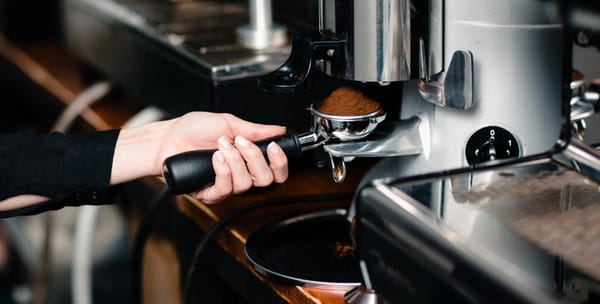
The answer should give itself away over the course of this piece, because at bottom AI and the coffee machine share the same mission — and it is about people.
When we first wrote about how MASH and Eventyrsport use AI, the aim was simple. Give employees answers in the moment they need them. But something happened. Today the AI bot is no longer just a tool. It has become their bot. A fixed point. A daily routine. An all-knowing colleague in your pocket.
At Eventyrsport it became obvious: after thousands of conversations, employees started talking about the bot as a natural part of the working day. And then came the question — entirely organically, from the staff themselves: “Can’t we give it a name?” That enthusiasm was the starting gun for an internal post: “What should our chatbot be called?”
How AI helps employees
When employees use the AI chatbot at MASH or Eventyrsport, something particular happens: they seek out knowledge themselves, find the answers and learn them. And that is no accident. It rests on a well-described phenomenon: the Information Gap Theory, described by George Loewenstein.
An information gap appears when there is a difference between what a person knows right now and what they need to know in order to act. It creates an inner tension — a restlessness the brain instinctively tries to close. That is the mechanism that switches on curiosity and learning. So it isn’t the answer itself that motivates. It is the absence of one.
An example from real life
Picture a new employee in the store. A customer asks: “What’s the difference between Gore-Tex and Helly Tech?” The employee isn’t sure, and an information gap opens up.
If the AI can give a correct answer right there, written in plain language, the learning lands immediately. Not because someone said it was important, but because the answer mattered in that exact situation.
From answers to confidence
The greatest value isn’t simply that the employee gets an answer. It is that they can ask freely, without hesitating — and without the awkwardness of having to involve a colleague. It creates a sense of both support and control, and it strengthens learning, self-management and engagement alike.
At MASH, AI has become part of the working day:
- Almost half of the questions are about HR: from absence and uniforms to how colleagues treat each other.
- A quarter are about the menu and drinks, often asked in the middle of service.
- A further 16% relate to allergies and special requirements, usually about feeling secure in front of the guest.
The people at MASH use the bot because it fits the flow of their work — and that shows in the guest experience.
We are not out to give AI a soul. But when people start giving systems names, finding reassurance in them and letting them spark curiosity, we have crossed the line from technology to relationship. And perhaps that is exactly what makes the difference — that AI doesn’t just answer you, it lifts you.
The data backs it up
In January alone, Eventyrsport’s AI bot handled more than 1,100 conversations. That is the equivalent of more than 93 hours of support and a documented ROI of 9× — without even counting onboarding, learning or psychological safety.
But the most remarkable part? The employees use the bot because they want to, not because they have to. Because it is available, precise and helps them inside their own flow. And because we analyse the conversations on an ongoing basis, we can identify gaps in knowledge and improve both the answers and the content beneath them.
At both Eventyrsport and MASH we now use AI not just to optimise, but to listen, analyse and build:
- What are people asking about?
- What don’t they know?
- What do they need to know?
- What does that say about the culture?
The AI training continues
We are already rolling our AI solution out across a range of industries, from retail and hospitality to manufacturing, offices and services. And although the context varies, we see the same patterns:
- Employees take ownership
- Managers feel a real load lifted
- A culture of questions, learning and knowledge sharing
So what do AI and a good coffee machine have in common? — Both make it that little bit better to come to work.